
Research & decisions
You save a good article, download a useful report, and collect a few screenshots. When it is time to write a recommendation, you still have to find out where a particular claim came from and why you preferred one option earlier.
A Topic can keep that reasoning with the material. Here, imagine choosing a knowledge base for a small team. The same approach works for a research assignment, a product proposal, or another decision you expect to revisit.
Start with the decision, not the folder
Create a Topic with a specific name. “Small-team knowledge base” makes it easier to decide what belongs than “Research.” In its direction, write something you would comfortably explain to a colleague:
We are a five-person team trying to bring scattered project documents together. New colleagues should be able to find things quickly, and maintenance should stay manageable. Compare search, collaboration, and maintenance effort. Complex approval workflows are outside this investigation. We need an options comparison and a trial plan.
This gives each source and conversation a shared question. You can revise the direction when your priorities change.
Keep a little of your own reasoning
Save web pages, PDFs, screenshots, and observations as notes in the Topic. For a valuable source, add why you saved it: “This covers the search problem we keep running into,” or “This option may need someone to maintain it.”
Keep a note focused on one source or idea where possible. If a claim later turns out to be weak, you can find its origin instead of searching through a large mixed extract. Check the AI result for conditions that a short summary might have dropped.
Use the Wiki to avoid rereading everything
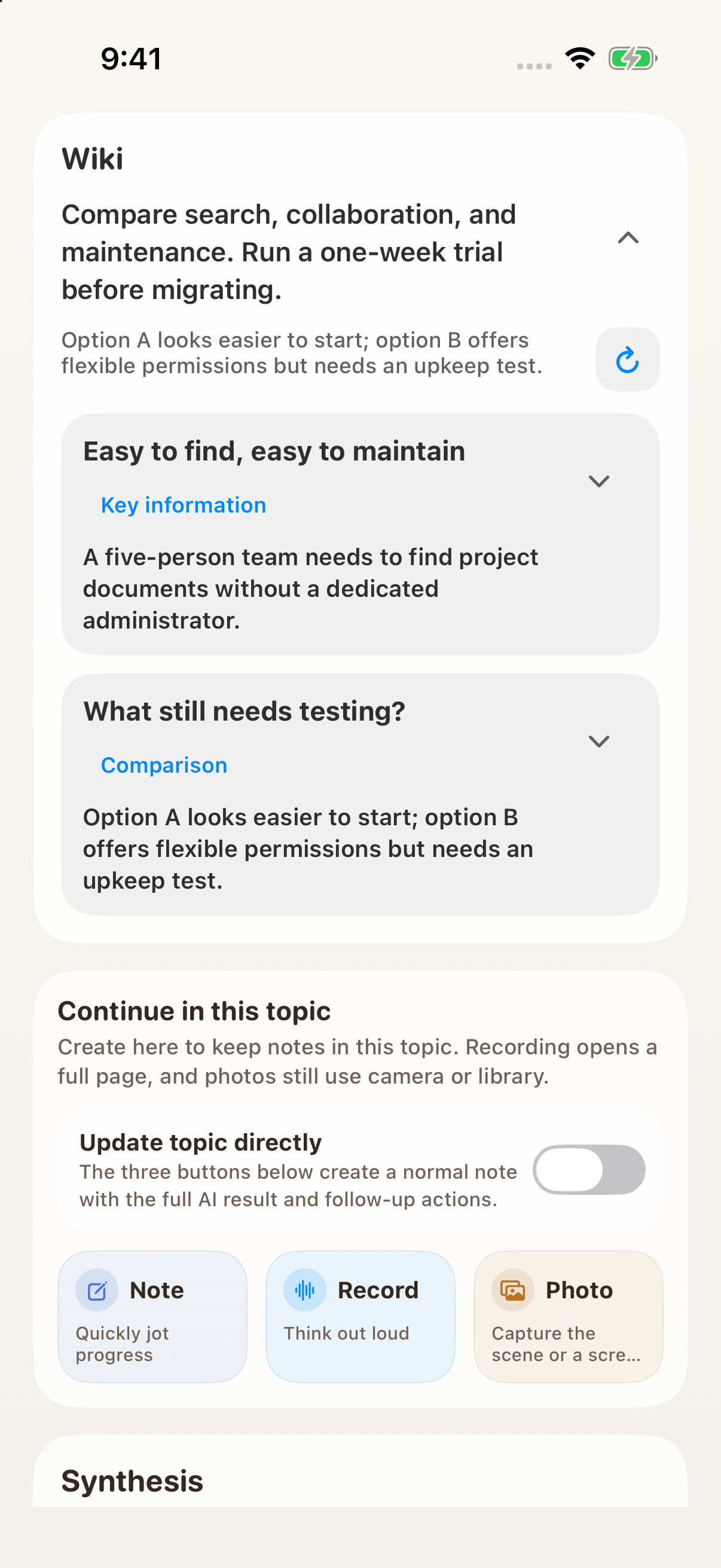
When there is enough material, generate a Topic Wiki. Use it for knowledge you will repeatedly need: option characteristics, established limitations, and shared terminology. Newly completed notes can update the existing Wiki.
Follow source links for important claims. If sources disagree, keep the disagreement visible until you can resolve it.
Compare against the same criteria
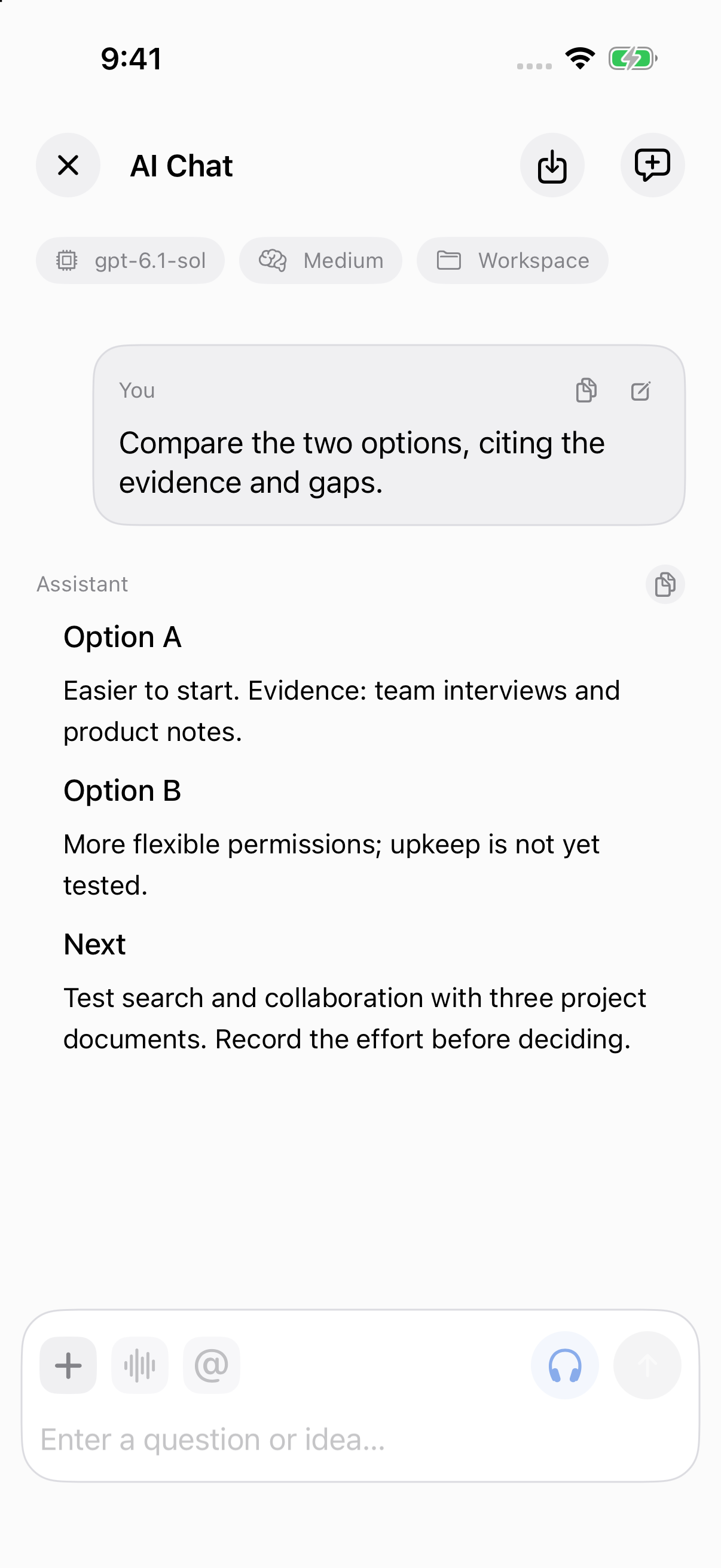
Start a conversation from the Topic. You can switch to live voice to talk through a trade-off without explaining the background again.
Compare the options by search, collaboration, and maintenance effort. Name the source notes behind each judgment, separate facts from assumptions, and leave unsupported details blank. End with the three most useful questions to test during a trial.
Then ask what would change if no one could maintain the system, or which apparent advantage has not actually been tested. Those questions may help more than collecting another ten introductions.
Leave a conclusion someone else can use
Generate a Topic outcome with the current preference, reasons, reservations, and trial tasks. Save it as a draft and revise it when the trial results arrive.
A useful conclusion explains what you currently prefer, why, and what evidence would change your mind. A colleague can continue the discussion, and you can understand the decision a month later. Keep new material in the Topic, stable knowledge in the Wiki, and this particular recommendation in the saved outcome.